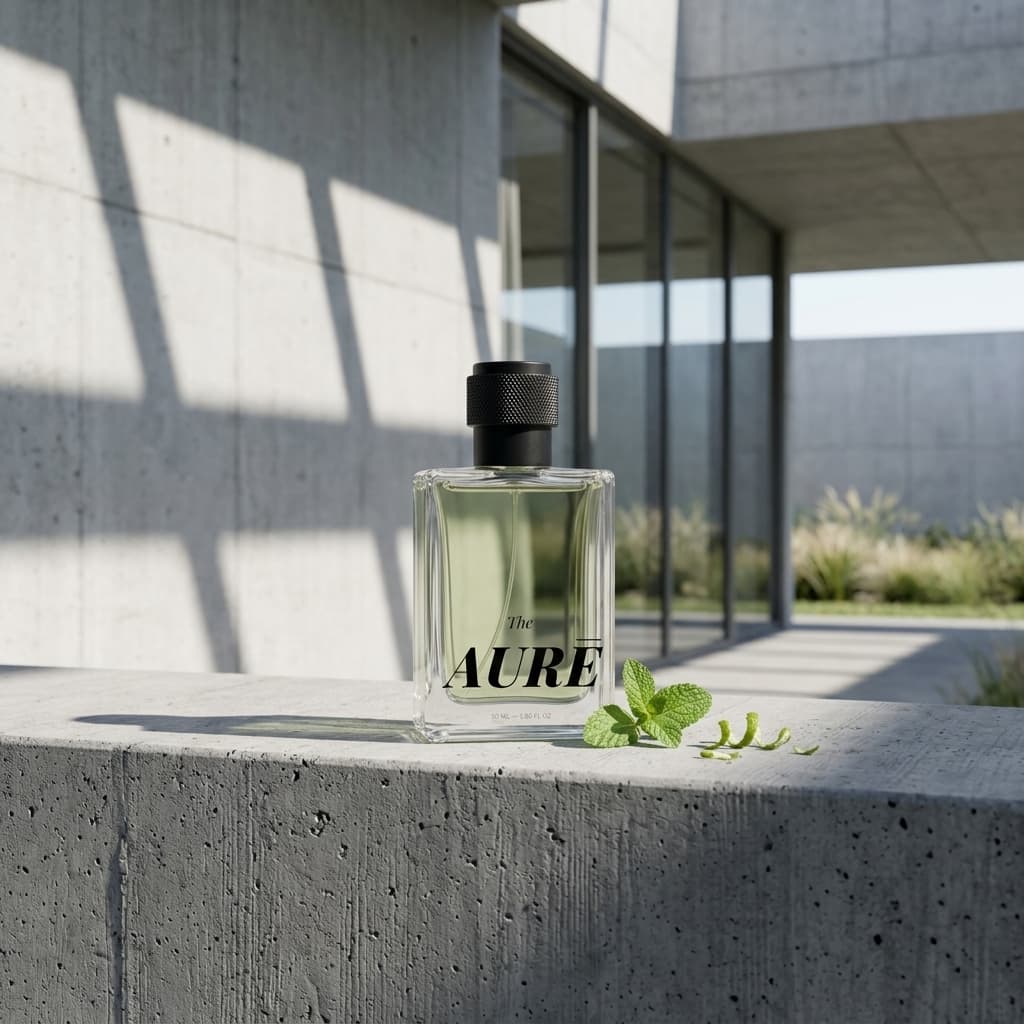
The Architecture of Silence
There is a specific geometry to silence in modern India. You find it in the quiet courtyards of Chandigarh, in the exposed concrete structures of Surat, and in the clean, unadorned walls of contemporary homes that seek refuge from the sensory density of the outside world.
Minimalist architecture doesn't try to fill space. It frames it. It uses raw materials—glass, steel, poured concrete—to capture light and shadow, leaving room for the inhabitant to breathe.
We design fragrance the same way.
In a market dominated by perfumes that shout—scents designed to project across crowded rooms and announce your presence before you arrive—we wanted to explore the opposite. We wanted to design the olfactory equivalent of a minimalist concrete wall. An architecture of silence.
The Raw Materials of Minimalism
In traditional Indian perfumery, complexity is often treated as a virtue. A single attar might contain dozens of heavy naturals—sandalwood, rose, vetiver, spices, and musks—layered until they form a dense, impenetrable cloud.
Modernist design works by stripping away. When you look at a building by Tadao Ando or Le Corbusier, there is no ornament. Every line is functional.
In molecular perfumery, this means working with a highly curated palette of synthetic and natural molecules. Instead of forty ingredients, we might use four.
Take Iso E Super. On its own in a beaker, it is almost imperceptible. It smells faintly of cedarwood, clean paper, and dry warmth. But when it touches warm skin, it acts like a clean concrete wall—it frames your natural skin chemistry, creating a quiet, hovering aura that comes and goes throughout the day. It is not an aggressive projection; it is a frame.
By pairing these clean molecules with precise natural extracts—a dry, mineral saffron or a cool, crisp vetiver—we create structured scents that feel spacious rather than crowded.
Designing the Space Between Notes
In architecture, the most important part of a building is the empty space inside it. The walls are simply there to define that space.
In fragrance, the empty space is defined by the evaporation rate of the molecules.
When we formulated our essences at 42% concentration, the goal was not to make them louder. In fact, increasing the concentration of fragrance oil actually slows down diffusion. Because there is less alcohol to evaporate quickly, the scent molecules are released gradually, staying close to the skin.
This slow release creates an intimate scent-scape. The fragrance doesn't force itself into the air around you. It remains in the space between you and someone else—a subtle, warm boundary that is only discovered when someone gets close.
It is the olfactive equivalent of a hidden courtyard.
How to Experience Quiet Scents
To appreciate a minimalist fragrance, one must unlearn the habits of commercial perfumery.
Do not search for a signature. A molecular fragrance is designed to adapt to your skin chemistry. It will smell different at noon than it did at nine, and it will smell different on you than it does on anyone else. Let the scent evolve without trying to label it.
Appreciate the pause. Because of how modern molecules like Ambroxan and Iso E Super interact with olfactory receptors, you may temporarily stop smelling the scent. This olfactory pause is normal. The scent is still there, framing your presence for those around you even when it goes quiet to your own nose.
Less is space. Spraying too much of a high-concentration fragrance doesn't make it cleaner; it simply crowds the structure. Two sprays on warm skin are all that is required to build your architecture of silence.
In a world that cannot stop speaking, the most sophisticated statement you can make is a quiet one.